Club Americano
Two clubs, one court time. Partners rotate within your own club, and every match faces the other side.
What is a Club Americano?
A Club Americano splits the field into two clubs and keeps them apart in a specific way: a partner always comes from the same club, and opponents always come from the other one. Inside a club, partners still rotate round to round the same way a Classic Americano works, so every player partners each of their own clubmates before anyone repeats. What never happens is a mixed-club pair.
It is built for exactly the situation the name suggests: two clubs, academies or friend groups sharing a session and wanting the afternoon to feel like a proper club-versus-club fixture, while individual scoring still means every player is chasing a personal ranking, not just a club total.
Both clubs need the same, even number of players for the draw to work. PadelEasy handles the rest: with 4 players a side, it draws 3 rounds in which every player has partnered every teammate from their own club exactly once, always facing the other club.
How it works
From two clubs turning up to a winner in four steps.
- Step 1
Split into two even clubs
Each club needs the same, even number of players. Four and four is the simplest starting point.
- Step 2
Draw the rotation
Partners rotate within each club; opponents are always the other club. Every round is set before the first serve.
- Step 3
Play each round to points
Every match runs to a fixed target, usually 16, 24 or 32 points, and both scores count for each player individually.
- Step 4
Highest total wins
After the last round, the player with the most points takes the day, from either club.
Scoring and ranking
Scoring is individual, exactly like a Classic Americano. The club split only decides who can be partnered and who is faced.
Points per match
Matches are played to a fixed total, commonly 16, 24 or 32 points.
Ranking
Players are ranked by total points scored across all their rounds, regardless of club.
Tiebreakers
Level totals are split by point difference, then by match wins.
Sit-outs
If one club has more players than the other side can match on court, the surplus rests that round, rotated fairly.
An example: 4 + 4 players, 2 clubs, 2 courts
This is a real schedule produced by the PadelEasy engine. Three rounds, and by the end every player has partnered every teammate from their own club exactly once.
Every match is a Club A pair against a Club B pair. Add more players per club and PadelEasy extends the same rotation.
Club Americano FAQ
Do both clubs need the same number of players?
Yes, and that number needs to be even on each side. Four and four is the smallest working split.
Can a player partner someone from the other club?
No. Partners always come from the same club; the other club is always the opponent.
How is the winner decided?
By total individual points across every round, same as a Classic Americano, regardless of which club a player is from.
What if the clubs are different sizes?
The format needs an equal, even split on both sides to work. Without that structure, a Classic Americano rotates everyone freely.
How many points should a match be played to?
16, 24 or 32 are the common targets. PadelEasy suggests one that fits the session time.
Run your Club Americano with PadelEasy
Everything on this page happens automatically in the app: split into two clubs, pick the courts, and the rotation draws itself.
Instant club schedules
Partners rotate within each club and opponents are always the other side, drawn in one tap.
Smart setup
Tell it the session time and it suggests points per match, so the last round ends on time.
Score from the court
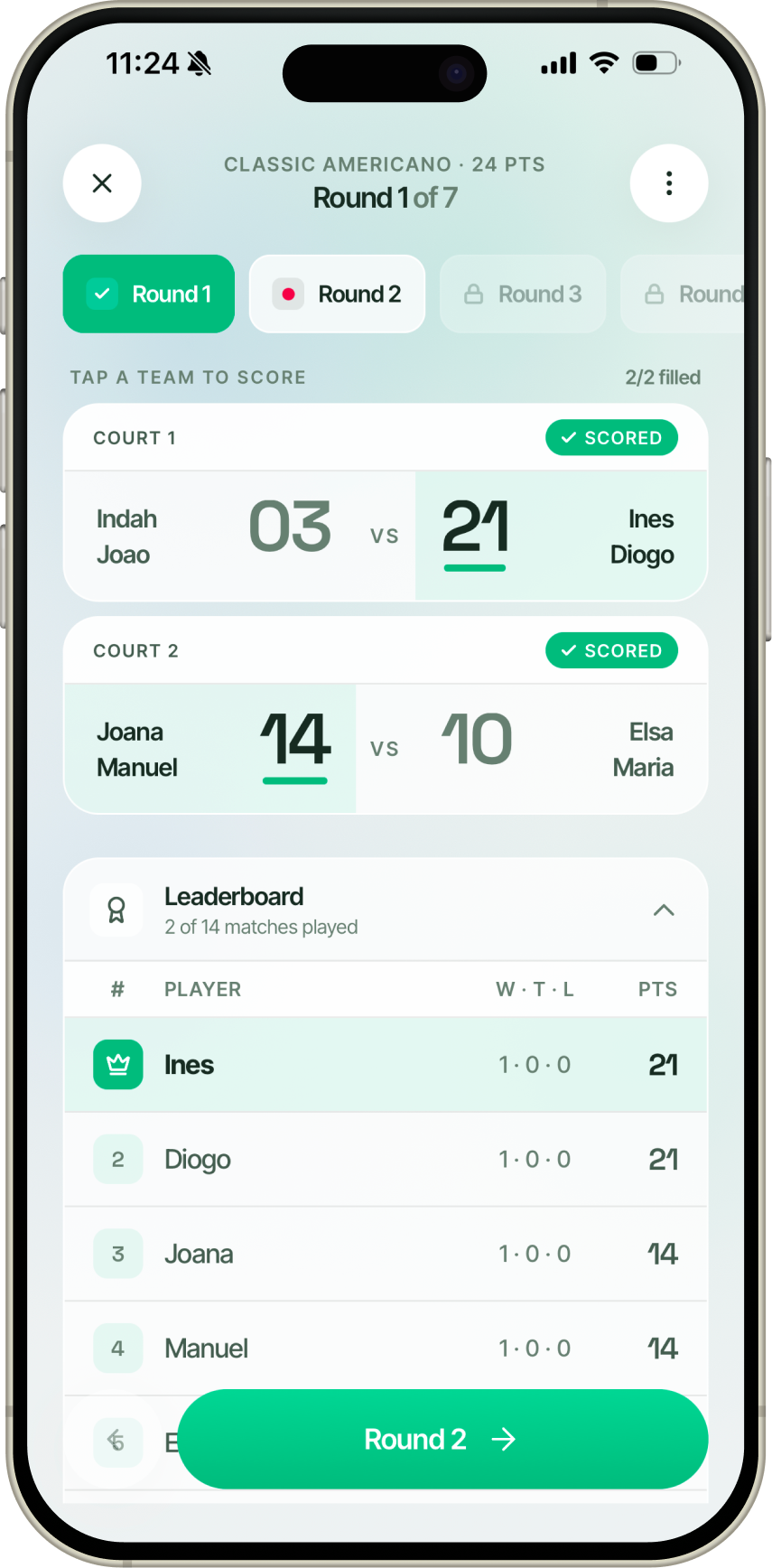
Tap a team, enter the points, done. The next round is already lined up and waiting.
Live standings for everyone
Share one link and friends follow along live in the browser. No login and no install needed.
Story-ready results
Take a photo at the end, get the standings laid over it, and share it straight to social media.
Playtomic import
Paste a Playtomic match link and the whole player list fills itself in, ready to draw.